Exposure science
Linking pollutant sources and concentrations to human behavior, the pollutant–host interaction, and the health outcome that follows — indoors, outdoors, and at work.
The RIPLRT Institute — the Respiratory and Immunology Project and Laboratory Research Team — turns environmental exposure data into predictive, translational, prevention-focused tools that improve respiratory health in Puerto Rico, underserved communities, and beyond. Through inclusive mentoring and science communication, we train the next generation of scientists and bring that science to the communities it serves.
We lead collaborative, multi-cohort studies that combine biospecimens, wearable exposure assessment, molecular profiling, and AI/ML modeling to identify critical environmental risk windows and separate biological from non-biological drivers of respiratory disease.
Linking pollutant sources and concentrations to human behavior, the pollutant–host interaction, and the health outcome that follows — indoors, outdoors, and at work.
Human whole-blood and cell-based assays that quantify the inflammatory potential of real-world environmental samples, aligning biomarker profiles with measured exposures.
Reproducible R, Python, and MATLAB pipelines, with code and data shared through GitHub, OSF, FigShare, and Zenodo so that findings can be checked and reused.
We measure environmental signals in communities, link them to clinical and biomarker outcomes, and convert them into equity-aware decision tools — with mentees embedded at every step.
At the RIPLRT Institute we prioritize mentoring the next generation of researchers and healthcare professionals. Mentees do not assist the science — they lead it, with structured training in laboratory technique, experimental design, documentation, project and budget management, scientific and grant writing, data science, science communication, peer review, teamwork, leadership, and career planning.
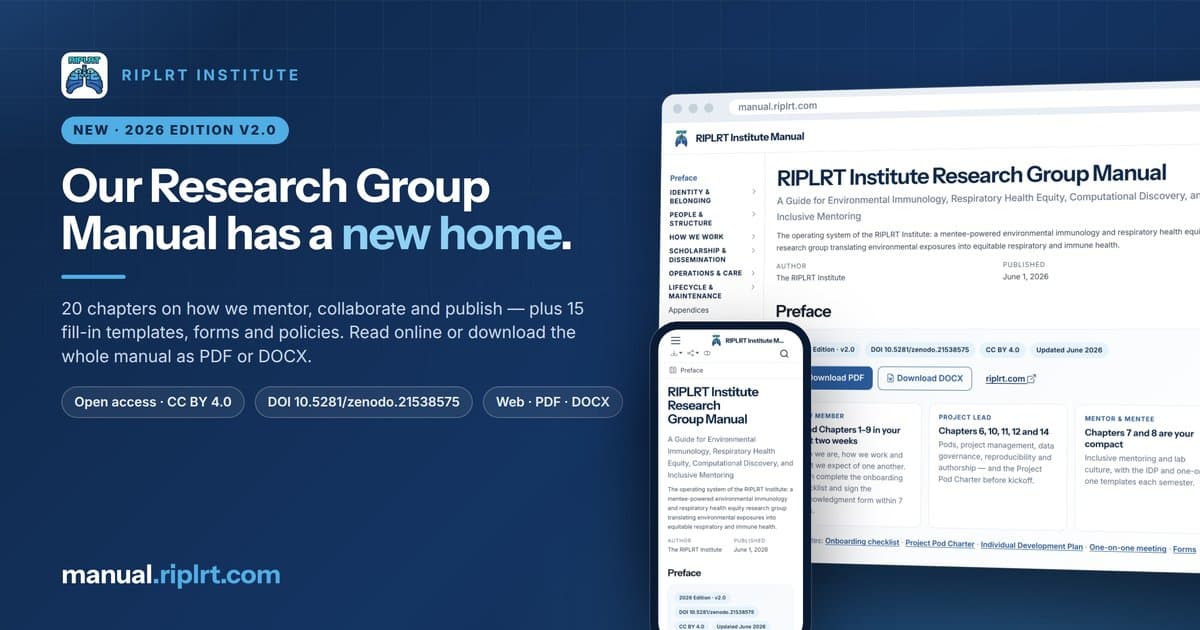
How we work together is written down in the RIPLRT Institute Research Group Manual — our mentoring compact, onboarding guide, authorship policy, and reproducibility standards in one place.
October 10, 2023
Dr. Lorraine N. Vélez-Torres defended “Indoor Fungal Bioaerosols after Hurricane Maria Related Flooding” on October 6, 2023.
February 27, 2023
How the storm reshaped the indoor built environment and indoor fungal contamination in naturally ventilated Caribbean homes.
2025
Culture and molecular methods applied to homes affected in the aftermath of Hurricane Maria, published in Scientific Reports.
We partner with clinicians, community organizations, and academic laboratories across Puerto Rico and the mainland United States. Tell us what you are working on.
Get in touch